
2026 Commercial Lighting Trends: Why “Brightest” Is No Longer the Only Standard
In 2026, global energy prices remain high, and many households dread their monthly electricity bills—especially in big cities like London, where heating and lighting costs in winter can account for over 20% of living expenses. At the same time, smart home systems are becoming increasingly popular, with devices like Alexa or Google Home allowing effortless control of home lighting. However, when selecting LED strip lights, people often fall into the trap of chasing “the brightest”—assuming higher brightness is always better. In reality, overly bright strips not only waste electricity but can also cause glare, affect sleep quality, and accelerate eye fatigue. According to the latest EU energy reports, high-efficiency LED strips in 2026 can help you save up to 30% on lighting costs—but only if you choose the right model. This guide, based on my personal experience as a home lighting enthusiast, helps you avoid those “blindingly bright but impractical” pitfalls and teaches you how to select a truly suitable high-brightness LED strip for your needs.
Breaking Down the Core Brightness Metrics for LED Strips: Lumens, Lux, CRI, and 2026 New Standards
To avoid falling for flashy merchant claims, first understand how brightness is measured. The most common unit is lumens (Lumens), which represents the total light output of the strip—for example, a 1-meter strip with 1000 lumens is enough to illuminate a small desk. Lux measures the light intensity falling on a surface, ideal for evaluating real-world usage (e.g., a kitchen countertop typically needs 500–1000 Lux to feel bright enough). Don’t overlook the Color Rendering Index (CRI), which determines how naturally colors are reproduced—CRI 80+ ensures food or clothing looks natural. In 2026, new metrics like R9 value (red light rendering) and TM-30 (overall color fidelity) are gaining importance, especially for high-end strips. High R9 prevents reds from looking dull, while TM-30 comprehensively evaluates all colors to avoid the issue of “looks bright but colors feel off.” In short, higher isn’t always better—these metrics should match your needs. For example, a photography studio demands CRI 95+, while a regular living room is fine with 80.

2026 High-Brightness LED Strip Mainstream Technology Comparison: COB vs SMD vs Mini-LED
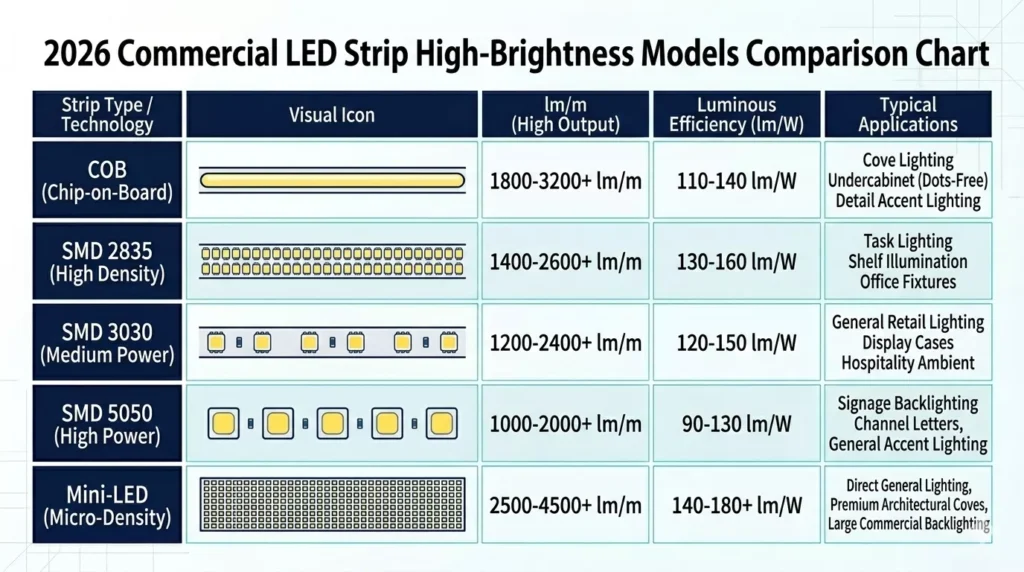
In 2026, the LED strip market is highly competitive, with high-brightness models mainly falling into COB, SMD series, and high-density Mini-LED. Based on the latest industry data, here’s a comparison of mainstream types (avoiding outdated specs). Note: These are average values; actual performance depends on density and power.
COB (Chip on Board): Chips are directly packaged on the board, producing ultra-uniform light like a continuous glowing strip. High brightness, typically 1500–2500 lm/m, with efficiency 120–150 lm/W. Ideal for dot-free scenes, but 20–30% more expensive and generates more heat (requires heat dissipation channels). About 30% brighter than SMD, but not suitable for curved installations.
SMD 2835: Small size (2.8×3.5mm); high-density versions (e.g., 180 LEDs/m) reach 1500 lm/m, efficiency 120–150 lm/W. The king of cost-performance, good heat dissipation, perfect for entry-level high brightness. But low-density versions (60 LEDs/m) only deliver 800–1000 lm/m—don’t get fooled.
SMD 3030: Square chip (3.0×3.0mm), higher efficiency (135–180 lm/W); high-density versions exceed 2000 lm/m. Wide CRI options, suitable for professional lighting, but higher power per LED (0.5W), so watch electricity costs.
SMD 5050: Classic RGB type (5.0×5.0mm); white versions 18–22 lm/LED, high-density (60 LEDs/m) around 1000–1200 lm/m. Slightly lower efficiency (~100 lm/W), but excellent multi-color effects; smart versions are popular in 2026.
Mini-LED: Emerging small-chip technology; high-density versions (300+ LEDs/m) easily exceed 2500 lm/m, efficiency 150–200 lm/W. Like an upgraded phone screen backlight—uniform brightness, but currently expensive. Best for high-end outdoor or photography use.
Overall, COB and Mini-LED are the 2026 “brightest” champions, but SMD 2835/3030 are more practical. If you’re on a budget, start with high-density 2835—you won’t go wrong.
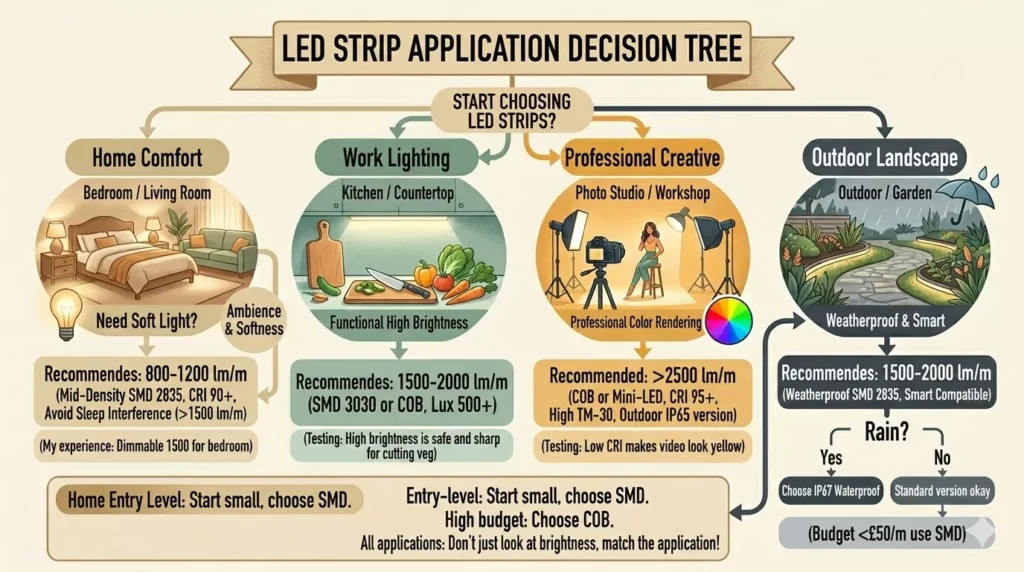
LED Strip Selection Decision Tree for Commercial Scenarios: Retail, Warehouse, Hotel—One-Click Matching
Don’t choose strips based solely on brightness—match them to the scene. Here’s a simple checklist to guide your decision step by step (I’ve used similar processes to help friends avoid many mistakes). First ask yourself: How large is your space? What’s the purpose? What’s your budget?
Bedroom/Living Room: Needs soft light—recommend 800–1200 lm/m (medium-density SMD 2835). Too bright disrupts sleep; I once installed 1500 lm/m in a bedroom and it felt like daytime at night—had to dim it immediately. Prioritize CRI 90+ to avoid color distortion.
Kitchen/Countertop: 1500–2000 lm/m (SMD 3030 or COB), Lux 500+. I tested it myself: low brightness makes chopping dangerous, while high brightness makes ingredients look vibrant.
Warehouse/Garage: Brightness first—2000+ lm/m (high-density Mini-LED or 5050). Dusty environments need waterproof versions. My garage with 1200 lm/m made finding tools a hassle; switching to high-brightness saved a lot of time.
Photography Studio/Workspace: 2500 lm/m+ (COB or Mini-LED), CRI 95+ and high TM-30. Outdoor versions add IP65 waterproofing. I once used low-CRI for video shoots—photos turned yellowish; hard lesson learned.
Outdoor/Garden: 1500–2000 lm/m (weather-resistant SMD 2835), smart-compatible. Question: Is there rain? Choose IP67. Budget under £50/meter—start with SMD.
My experience: Test in small spaces first—don’t buy long reels right away. High budget → COB; entry-level → SMD.
4 Hidden Factors That Truly Determine Actual Brightness and Lifespan
Brightness isn’t just about specs—these often-overlooked factors matter even more in the smart era of 2026.
Heat Dissipation (Importance of Aluminum Channels): High-brightness strips generate a lot of heat; without an aluminum channel, brightness can drop 30%. I recommend at least a wide channel—2026 aluminum alloy versions can double lifespan.
Driver Quality (Constant Current vs Constant Voltage): Constant current drivers maintain stable brightness; constant voltage ones flicker easily. Choose constant current for uniform output—I used cheap constant voltage once, and it dimmed after six months.
Voltage Drop Real-World Examples: Long strips (>5m) suffer voltage drop, dimming the tail end. I tested a 10m SMD 2835: head end 2000 lm/m, tail end only 1500—solved with thicker wires or parallel power supply.
Smart Dimming Compatibility (Matter/Zigbee): 2026 mainstream protocols allow remote brightness control. Choose compatible ones—otherwise you’ll buy smart-home gear but can’t adjust the lights.
Common Installation Failures for Commercial LED Strips and How to Avoid Them
Installing LED strips seems simple, but there are many pitfalls. Here are three real failures from my own experience to help you avoid trouble.
First, ignoring waterproof rating: I installed non-waterproof SMD 5050 in the kitchen—splashes caused short circuits and 50% brightness loss. Lesson: Kitchen/bathroom must use IP65+.
Second, wrong density: Garage with low-density 2835 (60 LEDs/m)—brightness insufficient, like going on an adventure to find things. Switched to high-density (120 LEDs/m)—instant paradise.
Third, compatibility issues: Bought cheap COB, connected to Zigbee smart system—constant flickering. Driver instability; ended up spending extra on a constant-current version.
In summary: Test voltage before install, use adhesive to secure, leave space for heat dissipation.
2026 Commercial LED Strip Future Trends and Bulk Purchase Recommendations
One-sentence summary: In 2026, the “brightest” LED strip isn’t about the absolute highest value—it’s the one that best matches your scene and budget. Prioritize efficiency and compatibility over chasing extreme brightness. Want deeper recommendations on specific models? Feel free to contact me! If you have questions, ask anytime—your lighting upgrade starts now.