
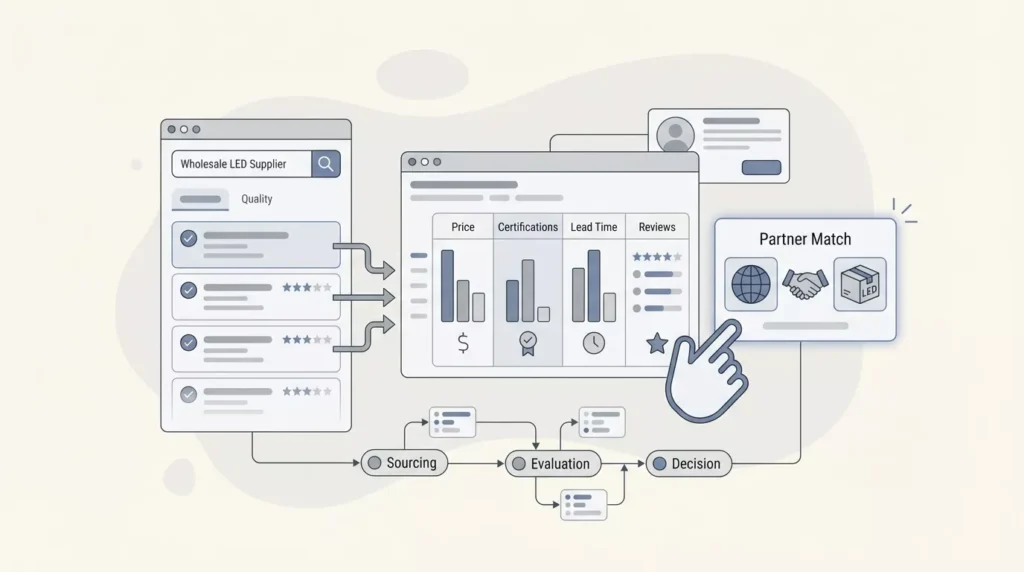

Let us break it down. The wrong supplier leads to inconsistent product quality, missed deadlines, and compliance headaches. The right one becomes a growth partner that helps you scale efficiently. This guide covers the seven critical criteria you need to evaluate when choosing a wholesale LED supplier, with practical insights from our experience as a manufacturer serving global B2B clients.
Why supplier selection matters
Poor supplier choices carry hidden costs that go far beyond the invoice price. When products fail prematurely or arrive with inconsistent specifications, you are left handling returns, managing angry customers, and repairing a damaged reputation. In the LED industry, there is also the matter of compliance. Selling uncertified electrical products opens your business to serious legal and financial liability.
The right supplier relationship works differently. Instead of a transactional vendor, you get a partner invested in your success. They help you navigate technical decisions, accommodate last-minute changes, and ensure your orders arrive on time and to specification. At IVSLED, we have seen this partnership dynamic firsthand with our wholesale clients across 50 countries.
There is also a fundamental distinction between working with distributors versus direct manufacturers. Distributors add a markup and may have limited technical knowledge. Direct manufacturers control quality, offer better pricing, and can customize products to your exact requirements. Understanding this difference shapes how you approach supplier evaluation.
Key certifications and quality standards
Certifications are non-negotiable in the LED industry. They are your assurance that products have been independently tested and meet safety and performance standards. Here is what to look for:
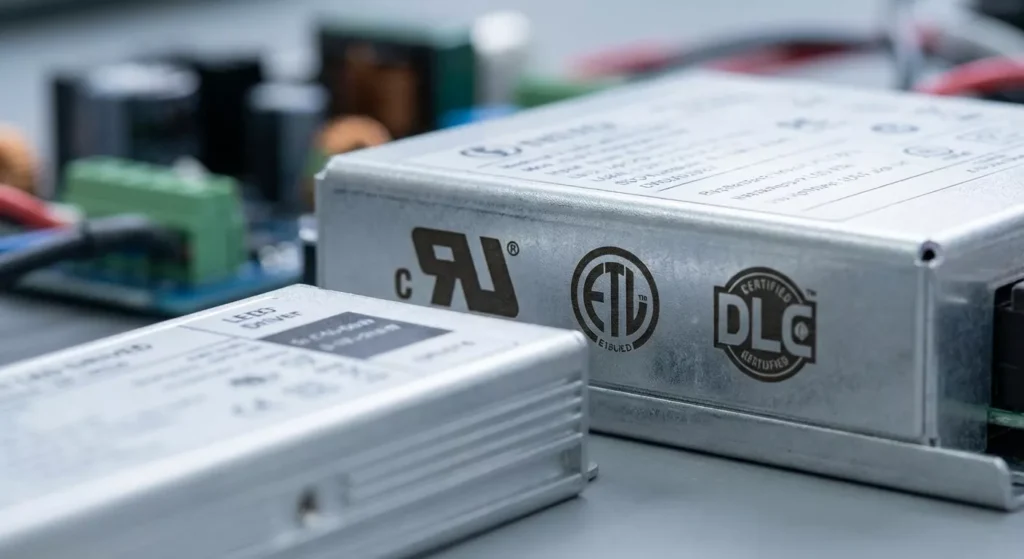
UL/ETL Certification indicates a product has been tested by a Nationally Recognized Testing Laboratory and meets stringent US safety standards. For commercial applications or any installation requiring electrical inspection, this certification is mandatory. Without it, you risk failed inspections and liability exposure.
DLC (DesignLights Consortium) certification focuses on energy efficiency and performance for commercial lighting. Products with DLC qualification may qualify for utility rebates, adding value for your customers.
ISO 9001 certification signals that a manufacturer follows quality management standards. It indicates documented processes, consistent quality control, and continuous improvement practices.
When evaluating suppliers, do not just accept claims of certification. Ask for documentation and verify it independently. Check expiration dates and confirm the certification applies to the specific products you are ordering. Red flags include vague answers about certification status or reluctance to provide proof.
Our LED Strip Lights carry the certifications required for global commercial use, including ISO 9001:2008 and IATF 16949 standards.
Evaluating product quality and consistency
Certifications are the baseline. To truly evaluate quality, you need to understand the components and manufacturing processes that determine product performance.
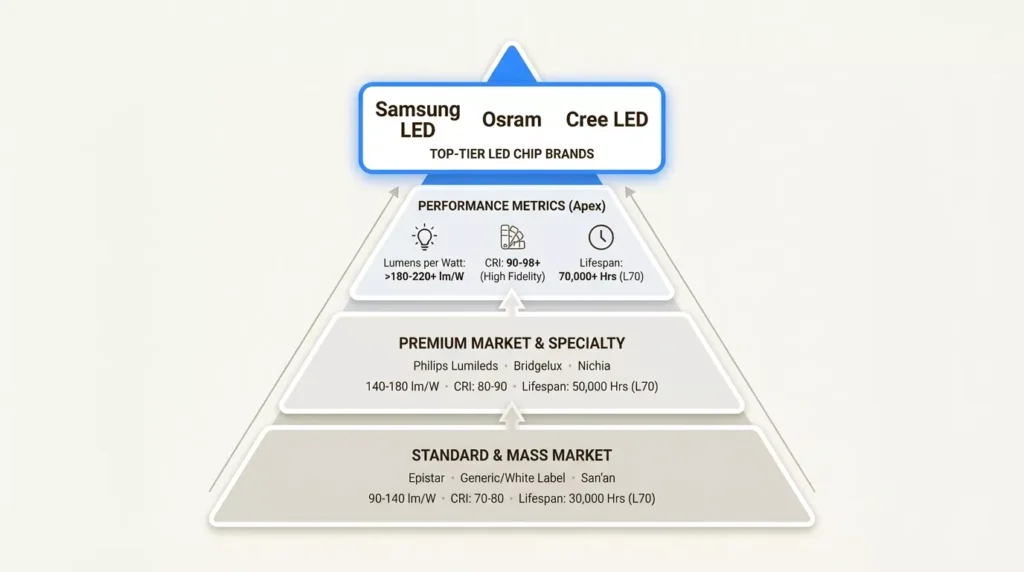
LED chip quality varies significantly by manufacturer. Top-tier options include Epistar, Cree, Osram, and Samsung. These brands offer better efficiency, longer lifespans, and more consistent color temperature. Lower-grade chips may look similar on paper but degrade faster and produce uneven illumination.
PCB specifications directly impact heat dissipation and product longevity. Look for 2-4 oz copper PCBs rather than the standard 1 oz. The additional copper weight improves thermal management, which is critical for LED lifespan. This is one of the specifications that separates commercial-grade products from consumer-grade alternatives.
SMT manufacturing (Surface Mount Technology) precision affects reliability. Ask about the equipment used. Japanese SMT machines from manufacturers like Panasonic or Yamaha offer higher precision than lower-cost alternatives. This precision matters for solder joint quality and long-term reliability.
Testing protocols reveal a supplier’s commitment to quality. At minimum, look for weak soldering testing, photometric testing for color accuracy, and aging tests to verify lifespan claims. The best suppliers test every batch, not just sample units.
Batch consistency is critical for wholesale orders. You need assurance that products ordered six months apart will match in color temperature, brightness, and physical specifications. This requires rigorous process control and material tracking. Learn more about our manufacturing standards on our LED Strip Light manufacturing page.
Understanding pricing and MOQ structures
Pricing evaluation goes beyond the per-meter or per-unit cost. You need to understand the full pricing structure and how it aligns with your business model.
Wholesale suppliers typically use one of three MOQ models:
| Model | Structure | Best For | Considerations |
|---|---|---|---|
| High MOQ / Low Unit Price | Large single-product orders | Big-box retailers, national chains | Requires significant capital, higher risk |
| Low MOQ / Tiered Pricing | Flexible mixed orders with volume discounts | Independent retailers, growing businesses | Lower entry point, scales with growth |
| No MOQ / Premium Pricing | Order any quantity | Testing new products, small projects | Highest per-unit cost, lowest risk |
Watch for hidden costs beyond the product price. Setup fees for custom specifications, tooling charges for unique designs, and shipping surcharges for small orders can affect your total cost. Get a complete pricing breakdown upfront.
When comparing suppliers, be wary of prices significantly below market rates. In the LED industry, rock-bottom pricing usually signals corner-cutting on components, testing, or certifications. The cost difference often shows up later in product failures and warranty claims.
For a customized quote based on your specific requirements, contact our team.
Assessing lead times and logistics
Delivery reliability can make or break your business. A supplier with great products who cannot deliver on time becomes a liability.
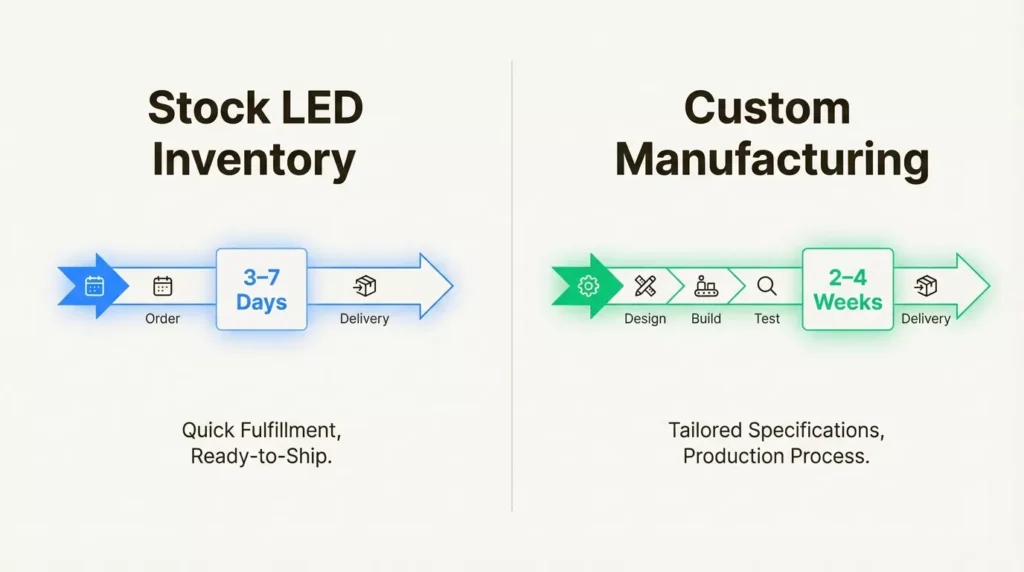
Standard vs. custom lead times differ significantly. Stock products should ship within 3-7 days. Custom products requiring specification changes, custom packaging, or OEM branding typically need 2-4 weeks. At IVSLED, we maintain stock for standard items and deliver custom orders in as little as 2 weeks, which is 50% faster than the industry average.
Warehouse location affects both lead times and shipping costs. Domestic warehouses enable delivery in days rather than weeks, with lower freight costs and easier returns processing. International shipping from overseas manufacturers operates on a timeline of months and introduces customs complexity.
Inventory management capabilities matter for ongoing relationships. Ask how suppliers handle stock levels, communicate backorders, and manage phased deliveries for large projects. The best suppliers offer real-time inventory visibility and proactive communication about potential delays.
Our LED Neon Light products ship from stocked inventory with flexible delivery scheduling to accommodate project timelines.
Vetting customer support and technical expertise
The quality of support you receive before and after the sale indicates how the supplier will handle problems when they arise.
Pre-sale consultation should be substantive, not just a sales pitch. Good suppliers ask about your application, recommend appropriate specifications, and provide technical documentation without requiring a purchase commitment. They should offer lighting schematics, photometric data, and installation guidance as standard practice.
Dedicated account management beats general customer service queues. Having a single point of contact who understands your business history and requirements streamlines communication and speeds issue resolution. Ask whether you will have a dedicated representative or be routed through a general support system.
Technical documentation availability reflects a supplier’s professionalism. Look for detailed specification sheets, wiring diagrams, installation manuals, and photometric reports. These materials are essential for your own customer support and regulatory compliance.
Warranty terms in the LED industry have shifted from the historical 1-year standard to 3-year minimums, with premium manufacturers offering up to 5 years. Read warranty details carefully to understand what is covered, the claims process, and whether replacement parts or full product replacement is provided. Also consider supplier stability. A 5-year warranty is worthless if the company is no longer in business to honor it.
For questions about our support structure or to speak with a technical specialist, contact us.
Red flags to watch for when evaluating suppliers
Certain warning signs should immediately disqualify a supplier or prompt deeper investigation.
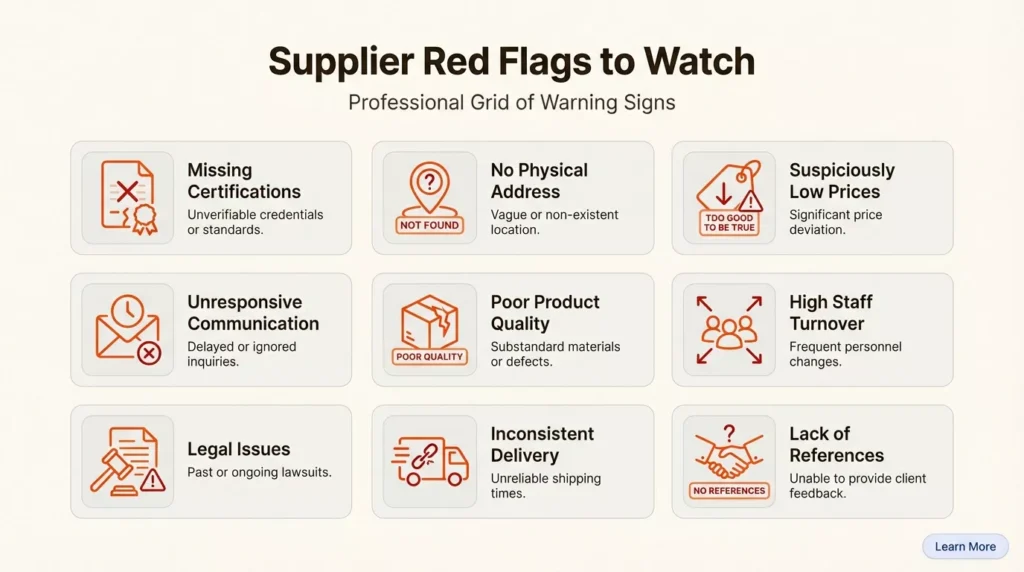
Unwillingness to provide samples before a bulk order is a major red flag. You should always test product quality before committing to large quantities. Samples let you verify specifications, build quality, and consistency.
Prices significantly below market rates often indicate substandard components, skipped testing, or counterfeit certifications. In the LED industry, quality components and proper testing have real costs. If a price seems too good to be true, it probably is.
No verifiable physical address or facility raises questions about legitimacy. Request factory audit opportunities or video tours. Legitimate manufacturers welcome transparency.
Pressure tactics or rushed decision timelines suggest the supplier is more interested in closing a sale than building a relationship. Professional suppliers understand that B2B partnerships require due diligence.
Poor communication during the initial inquiry phase predicts future problems. If emails go unanswered for days or responses fail to address your questions, expect similar treatment after you place an order.
Building a long-term partnership
The best supplier relationships develop over time through demonstrated reliability and mutual investment.
Start with trial orders to validate quality and service before scaling up. This reduces risk while you evaluate the partnership. Use these initial orders to test communication, delivery timelines, and product consistency.
Establish clear communication protocols. Define who your primary contacts are, expected response times, and escalation paths for urgent issues. Regular check-ins help catch potential problems early.
Scale volume gradually as trust builds. Most suppliers offer better pricing and terms for established customers. Volume growth should be matched with enhanced service levels.
Customization and OEM/ODM development become viable once a baseline relationship is established. This might include custom PCB designs, private labeling, specialized packaging, or unique product specifications. Our LED Aluminum Profile options demonstrate the customization possibilities available for growing partnerships.
Exclusive arrangements make sense at significant volume levels. These might include dedicated production capacity, priority scheduling, or custom product development. Such arrangements require commitments from both parties but create strategic advantages.
Choosing your wholesale LED supplier
Selecting the right wholesale LED supplier requires systematic evaluation across multiple dimensions. The suppliers who score well on certifications, product quality, pricing transparency, delivery reliability, and support quality are the ones worth building long-term relationships with.
Use a scorecard approach for objective comparison. Rate each supplier on the criteria that matter most to your business, weighted by priority. This prevents being swayed by a single factor, like low price, while ignoring critical weaknesses.
The right supplier becomes an extension of your team. They help you solve technical challenges, accommodate changing requirements, and grow your business. The wrong supplier becomes a constant source of problems and missed opportunities.
At IVSLED, we have built our business around being the supplier our clients rely on for consistent quality, competitive pricing, and responsive support. Our factory-direct model eliminates middleman markups while giving you direct access to engineering expertise and customization capabilities.
If you are evaluating wholesale LED suppliers, we invite you to request a quote and experience the difference a true manufacturing partner can make. Our team is ready to discuss your specific requirements and demonstrate why global brands like Walmart, The Home Depot, and IKEA trust us with their LED lighting needs.
Frequently Asked Questions
What certifications should I prioritize when finding the right wholesale LED supplier for my business?
Prioritize UL/ETL certification for safety compliance, especially for commercial installations requiring inspection. DLC certification adds value for energy efficiency rebates. ISO 9001 indicates quality management practices. Always verify certifications independently rather than accepting claims at face value.
How can I verify product quality before placing a large order with a wholesale LED supplier for your business?
Request product samples to test specifications, build quality, and consistency. Ask about LED chip brands (Epistar, Cree, Osram, Samsung), PCB copper weight (2-4 oz preferred), and testing protocols. If possible, conduct or request a factory audit to verify manufacturing capabilities and quality control processes.
What MOQ structure works best for small businesses finding the right wholesale LED supplier?
Low MOQ with tiered pricing offers the best balance for growing businesses. It allows you to start small and earn volume discounts as you scale. Avoid high MOQ requirements unless you have established demand and capital to support large inventory positions.
How important are lead times when evaluating a wholesale LED supplier for your business?
Lead times directly impact your cash flow and customer satisfaction. Stock products should ship within 3-7 days. Custom products typically require 2-4 weeks. Domestic warehouse locations significantly reduce delivery times compared to international shipping. Ask about phased delivery options for large projects.
What warranty terms should I expect from a quality wholesale LED supplier?
The industry standard has shifted to 3-year minimum warranties, with premium manufacturers offering 5 years. Read warranty details carefully to understand coverage, claims processes, and replacement terms. Also consider supplier stability. A long warranty from a company that may not exist in a few years provides little protection.
What are the biggest red flags to watch for when finding the right wholesale LED supplier for your business?
Watch for vague answers about certifications or manufacturing, unwillingness to provide samples, prices significantly below market rates, lack of verifiable facility information, pressure tactics, and poor communication during initial inquiries. Any of these should prompt deeper investigation or disqualification.